How to Spot a Fake Choice in Ten Minutes
A field guide to choice theater — the converging branch, the cosmetic flag, the delayed no — and a ten-minute test for games with meaningful choices.
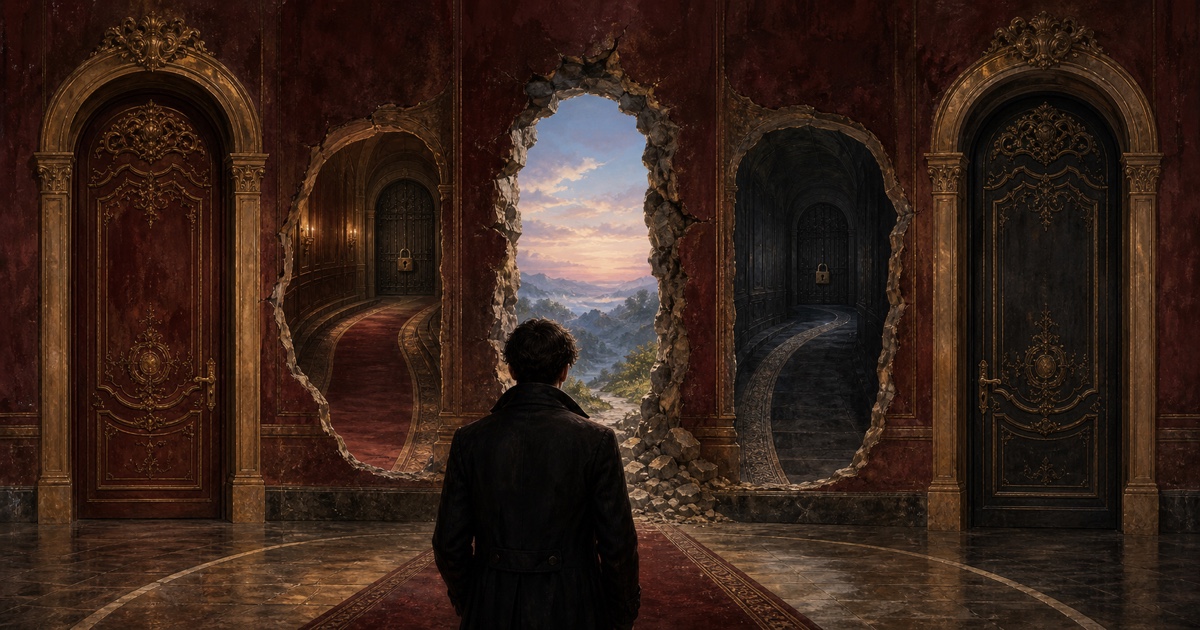
Choice theater is the practice of staging a decision without holding one. The lights come up, the options fan out, the music holds its breath — and then the story goes exactly where it was always going. The performance is often excellent. That is the problem. Players searching for games with meaningful choices keep walking out of these theaters vaguely cheated and unable to say why, because the trick is designed to survive a single playthrough. It only fails under inspection.
So here is the inspection. A short answer first: a choice is meaningful when the story would be recognizably different if you had chosen otherwise — different scenes, different obligations, different people who trust you. A choice is fake when every option feeds the same next scene and the difference survives only as a line of dialogue or a number on a meter. You can usually tell which kind a game deals in within the first ten minutes, if you know the four tells.
This is a field guide to those tells. Learn them once and you will see them everywhere — in blockbusters, in acclaimed indies, in the game a friend swears "totally reacted" to them. Then, at the end, what passing actually looks like.
Tell one: the converging branch
The oldest trick in the repertoire. You are offered a fork — spare the thief or turn him in, take the mountain pass or the river road — and both prongs bend back to the same scene within minutes. The thief you spared is arrested offscreen. The river road washes out and deposits you at the foot of the mountain anyway. The writers built one corridor and hung two doors on it.
Convergence is not a crime in itself. Every story that ships has to close some branches, and a game that never converged would be a hundred games in a trench coat, each one thin. The tell is not that branches merge; it is how fast and how completely. When a fork heals within a scene, leaving no scar — no absent character, no changed obligation, nothing you now cannot do — it was never a fork. It was a scenic loop off a highway.
The ten-minute test: take the option that seems structurally inconvenient for the story. Refuse the quest hook. Side with the obvious villain of the scene. Then watch how hard the game works to get you back on the road. A story with real branches lets the inconvenience ripple. A corridor snaps shut like a screen door.
Tell two: the cosmetic flag
The second tell is subtler because it involves genuine memory. The game does remember what you chose. It just remembers it the way a form remembers a checkbox.
You told the innkeeper your tragic backstory, and forty hours later a character references it — one line, applause line, done. You picked the sarcastic option in chapter one, and the epilogue narrator calls you "ever the wit." These are flags: single bits of state, set once, read back as garnish. They produce the sensation of being known without any of the consequences of being known. Nobody changes their plans because of a flag. No door closes. The flag is a mirror angled to catch your eye on the way past.
The tell inside the tell: cosmetic flags are always compliments to your attention, never constraints on your options. If the game's memory only ever surfaces as a wink — remember when you did that? — and never as a wall — you can't do this, because of what you did — you are looking at a scrapbook, not a history.
Tell three: the delayed no
This one is the most honest-looking and the most corrosive. The game accepts your choice warmly. It even plays it out for a while. And then, one scene or one chapter later, a contrivance arrives to quietly repossess it.
You spared the warlord: he dies of a fever before the treaty matters. You refused the crown: the council crowns you in absentia. You saved the village: raiders burn it during a cutscene so the third act can proceed as storyboarded. The game never says no to your face. It says yes, and — and then sends the yes upstairs to be overruled.
Why do choices never matter in story games that clearly spent money on choosing? Usually because of the delayed no. Branching is exponentially expensive when every scene is handcrafted; a team can afford to honor your decision for one scene, but not for twelve. So the structure develops an immune system. Deviations are tolerated locally and eliminated globally. The wound always closes, because the third act was finished before you ever sat down.
You will rarely catch a delayed no in ten minutes — that is what the delay is for. But you can catch its shadow: notice whether the early game ever lets a small yes stand unrepossessed. If even the trivial choices get walked back, the big ones will be too.
Tell four: the meter standing in for a reputation
The fourth tell wears a HUD. Somewhere on screen, a bar fills toward Paragon or Renegade, Honor or Infamy, and the game invites you to read that bar as how the world sees you.
But a reputation is not a scalar. A reputation lives in particular people: the merchant who saw you lie and tells her sister, the guard you humiliated who now outranks you, the town that heard one story about you and the road that heard another. A meter is what you get when a game averages all of that into a single number and lets the number make its decisions — this vendor's prices, that ending's cutscene. Two players with wildly different histories collapse into the same integer, and the world reacts to the integer.
The test here takes one minute: do two different people in the world hold two different opinions of you? Can someone be wrong about you? Can a rumor outrun the truth? If the answer is one bar, one tone, one uniform global attitude that ticks up and down like a thermostat — the game has a score where its society should be.
What games with meaningful choices actually do
Flip the field guide over and you get the positive print. In games where choices actually matter, four things tend to be true. Branches scar: when paths converge — and they will — you carry evidence of the one you took, in who is alive, who trusts you, and what you owe. Memory constrains: the past shows up as walls and obligations, not just winks. Yes means yes: the story would rather become a different story than repossess your decision. And judgment is particular: people form opinions about you, individually, unevenly, sometimes unfairly — the way people do.
Notice what all four have in common. Each one is cheap to fake and expensive to do, and the expense is the same in every case: the story has to be willing to change. Not decorate differently — change. That is why choice theater exists. It is not cynicism; it is what honest craftspeople build when every scene must be finished in advance. The performance of choice is the best that a fixed script can offer.
Which suggests where to look for the real thing: stories that are not fixed in advance. This is the bet an AI story game makes. In Runebook, the Storyteller runs the world, and you act by typing what you want to say or do — there is no menu of two doors on one corridor, because there is no corridor until you walk it. Spare the thief and he exists now, with your mercy in his pocket, free to repay it or sell you out. The story remembers what matters — not as a flag to wink at you, but as material the world keeps building with. If that shape of play is new to you, the case for being the protagonist rather than the audience is laid out in what it means to play a game where you are the main character, and there is a longer look at how choose-your-own-story games change when the branches aren't pre-written.
Run the test yourself
Ten minutes is enough. Take the inconvenient option. Watch for the scar, the wall, the unrepossessed yes, the neighbor who judges you differently than the town does. Any story game on your shelf will show you, quickly, which kind of theater it is.
Or start with one where the test is the game. Pick a fantasy, a mystery, a romance — or build a story from your own idea — and make a choice the script could not have seen coming, because there is no script. Create an account and start your first story — it's included. Start your story.