The Main Character Test
Everyone jokes about main character energy. Here is what it would take for a game to actually grant it — and why almost every game fails the test.
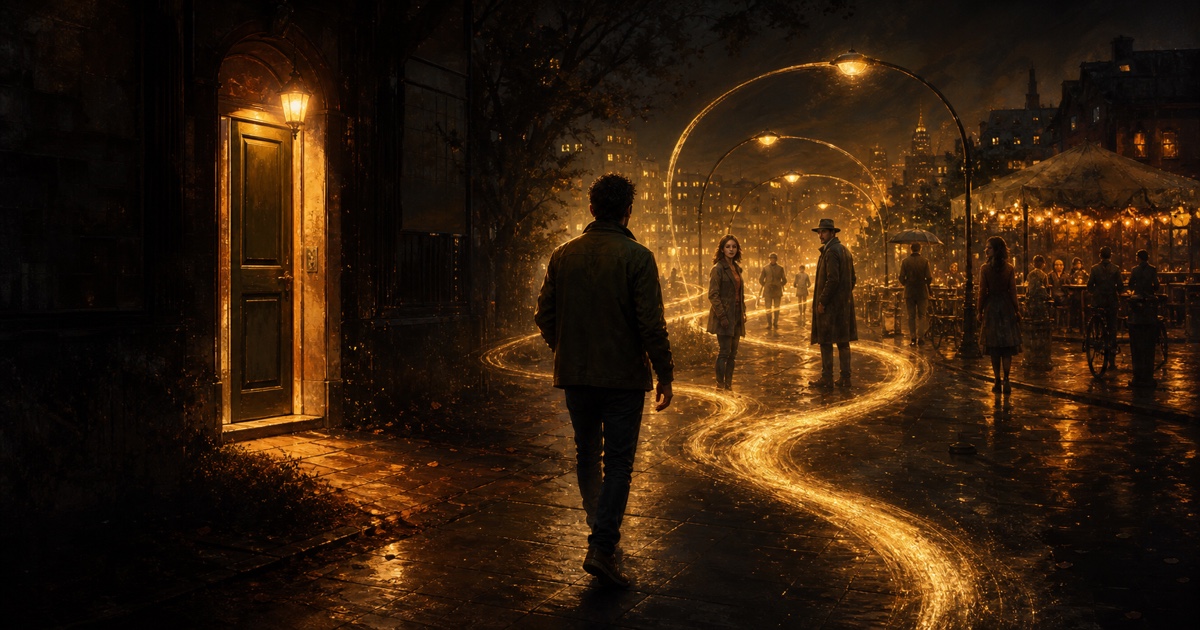
"Main character energy" is the internet's favorite way of teasing its friends. It's what we call ordering dessert first, walking through rain as if the weather were cinematography, narrating a commute like a trailer. The joke lands because of the barb inside it: none of us actually gets to be the main character. The bus leaves anyway. The rain is just rain.
But type "game where you are the main character" into a search bar and the joke turns sincere. Underneath the irony is one of the oldest wants a reader has — not to watch a protagonist, not to steer one from behind, but to be one. To stand inside a story that treats you as the reason it is happening.
A game where you are the main character is not a game that calls you the hero; it is a game where the world reorganizes around what you do. The test has three parts: people remember your actions, doors close because of your choices, and consequences compound over time. Most games — including some of the most beloved ever made — fail all three.
Call it the Main Character Test. The rest of this essay is what failing and passing feel like, and what it would actually take to pass.
Failing the Test
You know the fire was real because you were there. In the story's opening hour you dragged the miller's daughter out of the burning granary, and the whole town stood in the square and watched you do it. Twenty minutes later the miller sells you bread at full price and calls you "stranger." The guard you hauled from under a beam asks if you're new in town. A quest marker floats serenely on to the next objective. The chapter was finished before you arrived, and everyone in it behaves accordingly.
That is the standard failure, and once you notice it you cannot stop noticing. The plot happens near you. You are present for the murder, the coronation, the betrayal, and every scene would play out identically for anyone standing on your square of floor. The game has cast you as a camera with legs.
The sharper failure is the cutscene, because a cutscene spends your agency for you. You have been careful for ten hours — checked every room, trusted no one — and then the screen letterboxes, and "you" hand the relic to the obvious traitor, because the third act requires it and you were the nearest protagonist-shaped object. When control returns, you are meant to feel betrayed by the traitor. You feel betrayed by the script.
Even conversation fails, politely. The dialogue menu offers three options: yes; a sarcastic yes; a question whose answer leads back to yes. The thing you actually want to say is never on the list, because the list was written by someone who could not have known you would be standing here, like this, wanting to say it.
Passing the Test
Now run the test the other way, one part at a time.
People remember. Early in the story you made a cheap joke at a ferryman's expense — something about his leaking boat. You barely noticed saying it. Much later the river is in flood, his is the only crossing for miles, and he looks at you for a long moment before naming his price. No notification fires. No meter moves. The story simply knows, the way people know.
Doors close. You held the magistrate's letters, and there were two kinds of power in them: keep them quiet and own her, or read them aloud in the square and end her. You read them aloud. The town turned; she fell; and the quiet version of that power is gone for good, along with everything it might have bought. This is the part players claim to hate and secretly need. A closed door is the proof that the open one was real. A story in which you can eventually have everything is a story in which you never chose anything.
Consequences compound. At the gate the lie was free: you are the new apothecary, just passing through. That night it bought you a bed. A week later a man is pounding on your door with a feverish child in his arms, because in this town you are the apothecary, and the lie has started collecting interest. That is what compounding means — grudges, favors, debts, and reputations, each one quietly earning.
A game that passes all three feels different in the body. The story stops being a corridor and becomes a place. You stop performing a hero and start behaving like someone who lives there. That is the difference between a story that happens near you and a story where you are the main character: your name comes to mean, to the people around you, exactly what you have done.
Why Almost Every Game Fails
Not out of laziness — out of arithmetic. A game where you decide what happens has to fork every time you decide, and forks multiply. Ten meaningful choices with honestly different outcomes is a thousand different stories; twenty is a million. No studio can hand-write a million stories, so every branch must sooner or later bend back toward the trunk. Reconvergence is how the budget survives. And reconvergence is exactly what the test forbids, because a world that must return to the script cannot keep reorganizing around you.
So designers, who are not fools, buy the appearance of consequence instead. A small note glows on screen to assure you that someone will remember what you did — famous mostly for how rarely anything comes of it. A reputation number stands in for a reputation. Two endings differ by a closing speech. The cutscene endures because reconvergence needs an enforcement arm: something to take the wheel at the moments the branches must merge.
None of that is contempt for players. It is simply what fiction costs when all of it must be written in advance. A finished story is finished. You cannot be the main character of something that ended before you arrived.
The Storyteller Who Passes
There has always been one storyteller who passes the test, and it was never software. At a kitchen table where one person runs a game for four friends — the tabletop tradition calls this person the game master — the world reorganizes around the players every single week. Not because that one person out-writes a studio, but because they compose the next scene after your choice instead of before it. They remember the ferryman because they were there when you insulted him. Doors stay closed because they keep faith with what happened at their own table.
The whole trick of being inside a story, it turns out, is sequence: the story must be written after you act, not before. Which explains the scarcity. A game that puts you inside a story has always had one hard requirement — a patient human with free evenings, a long memory, and a gift for improvising a world — and most people never get one. The want persisted anyway. It is right there in the search terms.
A Game Where You Are the Main Character
That want is what Runebook was built for. Runebook is an AI story game. The Storyteller runs the world: it narrates each scene, plays everyone in it, and then waits — actually waits — to find out what you do. You act by typing what you want to say or do, accepting a suggested action, or speaking it aloud. There is no menu of three yeses. If what you want is to apologize to the ferryman, or to lie better this time, or to read the letters aloud in the square, you say so, and the next scene is composed from there — narrated aloud, with imagery for the scene as it unfolds.
Run the test on it. People remember, because the story remembers what matters: the grudge, the kindness, the false name you gave at the gate — we have written more about how story games carry memory. Doors close, because words have weight and the people you say them to are free to mind, which is the heart of what happens when you can say anything to Elizabeth Bennet. And consequences compound, because each scene is written after your last choice, out of everything that came before — which is what it actually means to choose your own story rather than select one from a list.
The shape of the story is yours as well: fantasy, mystery, romance, horror, historical, manga-style, sci-fi, or something built from an idea only you have. You can be the only main character, or bring friends into the same story and watch a world reorganize around all of you at once — which, at any good kitchen table, was always the best part.
Take the Test Yourself
"Main character energy" will go on meaning what it means: dessert first, rain as cinematography, protagonism as a bit. It is a good joke. But energy was never the missing ingredient. What is missing is a world willing to grant the office — to remember what you did, keep closed what you closed, and carry all of it forward. Create an account and start your first story — it's included.
The ferryman is willing to forget that joke about his boat. He would like to hear you say so yourself. Start your story.