A Story Built From One Sentence
You have the premise — the lighthouse keeper, the eclipse heist. Here's what happens between the one sentence and scene one, and the game that gets you there.
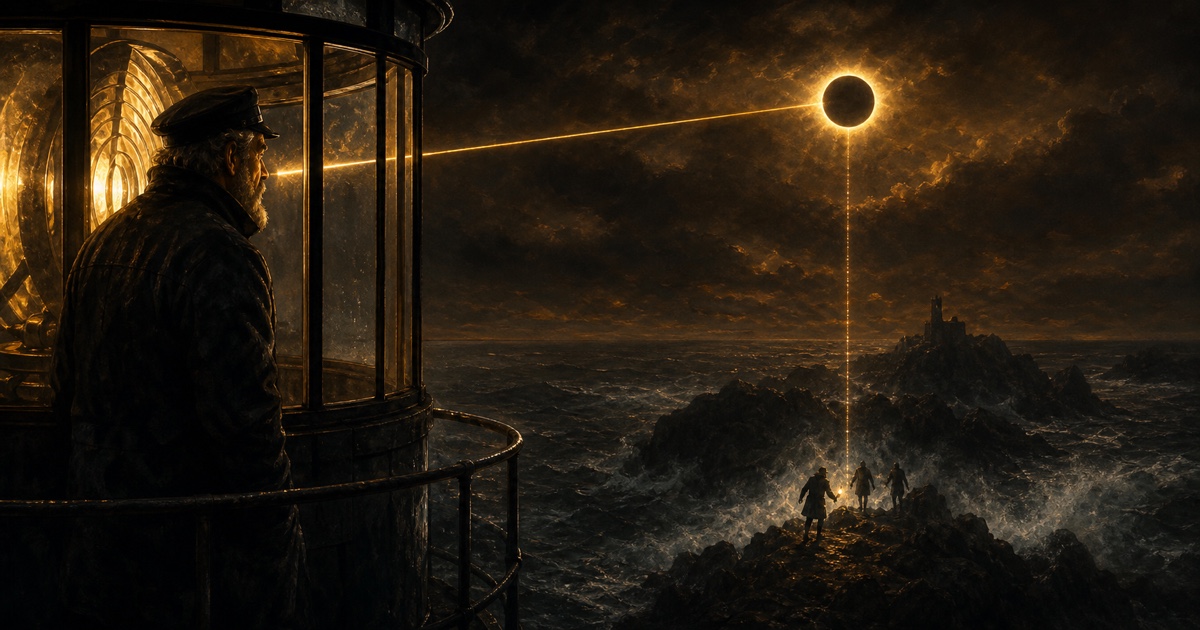
Premises arrive in places where you cannot write them down. The shower. The train window, when the light is doing something strange to a row of houses and you suddenly think: a city where lying is illegal. The last minute before sleep. The middle of someone else's story, when a minor character walks off the page and your mind follows them out: the lighthouse keeper is signaling someone. Who?
They arrive complete — one sentence, fully lit — and then they die of nowhere to live. If you've ever searched for a game that turns your ideas into an adventure, this is almost certainly why: you can feel the whole story inside the sentence the way you can feel a whole house behind a front door, and every door between the two seems to be labeled learn to write a novel first.
There is now a real answer to that search. A game that turns your ideas into an adventure takes a one-sentence premise — no outline, no draft, no craft — and builds a living story around it, with you inside as a character rather than the author. You describe the world; the game furnishes it, gives you a place to stand in it, and asks the only question that matters: what do you do? The rest of this essay is about what actually happens between the sentence and scene one — and why the person who has the idea was never the problem.
The unfinished country of good ideas
Be honest about how many you're carrying. Most people, asked directly, can produce three or four premises on the spot, and they're usually good — genuinely good, the kind a development executive would circle. The innkeeper who remembers every guest except one. The town that holds a funeral for the living. The heist that can only happen during the eclipse. The kingdom where the maps are alive and the borders move at night. The two rival smugglers who keep saving each other's lives by accident and are running out of ways to pretend it's an accident.
The standard advice for what to do with a premise is: write it. Keep a notebook. Draft an outline. And this advice quietly ends most premises, because it hands the idea-haver a job they never asked for. Having ideas and drafting prose are different appetites. One is a flash; the other is a discipline. Telling someone with a great premise to go write eighty thousand words is like telling someone who loves a song to go learn luthiery.
So the notebook fills up — or worse, doesn't — and the sentences sit there. A premise on a page is a strange object. It isn't a story yet. It's a promise of one, and promises age badly in drawers. Six months later you find the city where lying is illegal in your notes app and feel a small grief you can't quite name: the grief of a place you never got to visit.
Notice the word. Visit. Not write. That's the tell. What most idea-havers actually want isn't authorship. It's entry.
What has to happen between the sentence and scene one
Here's the part the notebook can't do, and the part worth understanding, because it's where a premise becomes a place.
A premise is a rule. Lying is illegal. For it to become a world, the rule has to be asked a hundred small questions. Who enforces it? What counts as a lie — flattery? fiction? a kind word to the dying? Is there a black market in falsehood, whispered untruths sold in back rooms like contraband? What does the architecture look like in a city with nothing to hide — all glass? no curtains? And who, in this city, is about to need to lie very badly?
That last question is the hinge. A world becomes a story the moment it produces a person under pressure. The lighthouse keeper's secret is only interesting when someone rows out to the lighthouse. The eclipse heist only breathes when there is a crew, a clock, and a thing worth stealing that can only be stolen in four minutes of dark.
Writers do this expansion by hand, over months, and much of it is genuinely tedious — continuity, logistics, the plumbing of a plot. But notice what the expansion actually requires from its originator: not prose. Not structure. It requires answers, and answers are just decisions, and decisions are the one thing the idea-haver was always equipped to make. You know whether your lighthouse keeper is protecting someone or imprisoned by them. You've known since the shower. Nobody ever asked you.
A game that turns your ideas into an adventure
This is what an AI story game changes, and it's worth being precise about what the change is. It doesn't write your novel for you. It removes the novel as the toll you pay to find out what happens.
You bring the sentence. The game — in Runebook's case, a Storyteller that runs the world while you act inside it — takes the premise and does the hundred-questions expansion in real time, then does the crucial thing a notebook never could: it puts you in the story as a participant instead of a stenographer. You act by typing what you want to say or do, and the world answers. The keeper's tower has a locked room; you can knock, pick the lock, or ask him about it over the gutting of fish and watch his hands go still. The story unfolds scene by scene, with narration and scene imagery for the places your sentence implied but never had to describe.
And your decisions accumulate. The story remembers what matters — the name you gave the boat, the lie you told in the illegal-lying city and to whom — so the world you seeded with one sentence grows rings, like a tree. Leave for a week and come back; the story remembers where you were. The premise stops being a scrap in a drawer and becomes a place with your footprints in it.
The genre doesn't matter, or rather, it matters exactly as much as your sentence wants it to. A premise like the funeral for the living wants to be mystery or quiet horror; the rival smugglers is romance wearing a trench coat; the moving borders is fantasy with a cartographer protagonist you haven't met yet. Some premises are really a door out of your own life entirely — if your sentence starts what if you woke up somewhere else as someone else, that's its own beloved tradition, and there's a whole way to play being reborn into another world. Some premises are less about the world than about who you get to be inside it — the pull of finally being the main character instead of the audience.
What all of them share: the sentence was always enough. It just needed an engine instead of an executor.
You don't have to draft anything. You have to be willing to find out.
There's a quiet dignity worth defending here. Culture treats the idea-haver as a lesser creature than the writer — ideas are cheap, execution is everything — and there's truth in that for publishing. But finding out what happens inside your own premise was never a publishing problem. It was an access problem. The eclipse heist doesn't need to be a book. It needs to be Tuesday night, with the clock running and the light failing and you, in the vault, discovering that you would absolutely leave the paintings and take the letters, which tells you something about the story and about yourself.
That's the honest trade an AI story game offers: you surrender the fantasy of someday writing it, and in exchange you get to actually go. You can go alone, or bring friends into the same story and find out what they'd do during the eclipse. It plays in a browser; the barrier to entry is the sentence you already have. If you want the fuller picture of how this kind of play works — how a premise becomes a story shaped around your choices rather than a script you follow — that's the place to start reading.
But reading is optional. The sentence is the ticket. You've been carrying it since the shower, the train, the last minute before sleep. The lighthouse keeper has been signaling all this time.
Create an account and start your first story — it's included. Go find out who he's signaling.