Different Every Time, on Purpose
Shuffled maps give you variety. Responsive stories give you difference. Why games that are different every time split into two species — and which one lasts.
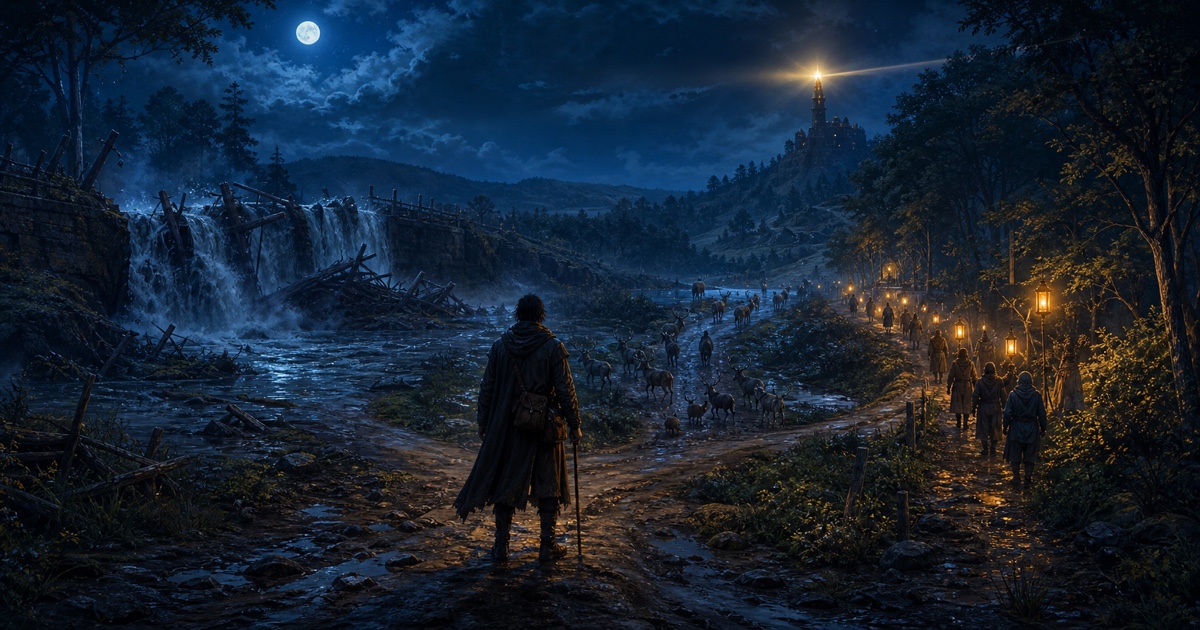
There is a particular silence that falls over a story the second time through. The first playthrough of a great narrative game can feel like a séance — the world alive, the outcomes unknown, every door a real question. Start it again and something has drained away. You know the twist. You know which door the killer comes through. The lines that stunned you now arrive on schedule, like a train. The story didn't get worse. It got known, and a known story asks nothing of you.
This is why people go looking for games that are different every time — call it the second playthrough problem. But that search splits, almost immediately, into two very different answers — and most of what you'll find only delivers the first one. Games that are different every time come in two species: games that shuffle their content, so the layout changes while you stay the same, and games that respond to you, so the story changes because you changed. The first kind gives you variety. The second gives you difference. They are not the same thing, and only one of them survives the hundredth hour.
That distinction sounds fussy until you've felt it. So it's worth taking slowly.
The shuffled world: new layout, same you
The most famous answer to the second playthrough problem is the roguelike. Procedural dungeons, randomized item drops, permadeath that resets the board. Every run is genuinely new in the sense that no two floor plans repeat, and the genre's best entries are marvels of design — machines for generating fresh tactical puzzles forever.
But notice what the shuffle actually varies. The corridors move. The loot table rerolls. The boss appears on floor four instead of floor six. What never varies is the relationship: the game asks you the same question every run — can you survive this arrangement? — and you give it the same kind of answer, just with different corridors. The variety is spatial and statistical. It's real, and it's often enough. Plenty of players want exactly this: a reliable ritual with unreliable furniture.
The tell is what happens when you describe a run to a friend. You describe the build, the drops, the death. You almost never describe yourself, because you were the same person in every run. The shuffled world varies everything except the one variable that makes stories interesting.
And that's why the shuffle, applied to narrative, mostly fails. A mystery with a randomized culprit feels arbitrary rather than authored. Branching dialogue trees, replayed, become a checklist — you're not living a different story, you're auditing the paths you skipped. Shuffled content answers "what's behind the door this time?" It cannot answer "who am I this time?" For that, you need the second species.
Responsive difference: the story changes because you do
Imagine a story that isn't a fixed structure with movable furniture but something closer to a conversation. Not a script with branches — a listener with a voice. In a responsive story, the difference between playthroughs isn't generated by a shuffle. It's generated by you: what you choose to say, whom you decide to trust, whether you draw the blade or ask a question, whether you're patient with the frightened innkeeper or brusque with her. Two people can walk into the same premise — a manor, a murder, a storm coming — and get stories that diverge not in layout but in meaning, because the story is answering two different people.
This is the deeper sense of "different every time," and it's what a story with no predetermined ending actually promises. When the ending isn't written in advance, replaying isn't re-treading; it's re-asking. The question the story poses — what will you do? — has a different honest answer every time you're a different person answering it.
And here's the quietly strange part: you are a different person, more often than you think.
Same premise, different day, different you
The strongest case for responsive difference isn't that it distinguishes you from other players. It's that it distinguishes you from yourself.
Say you spend an hour inside a story on a Tuesday night after a hard week. You play cautious. You hedge, apologize, take the safe road out of the burning village. Come back to the same premise a month later, rested and a little reckless, and you cut the rope bridge behind you just to see what the story does with it. A shuffled game would hand both versions of you the same question with different scenery. A responsive story hands your caution one story and your recklessness another — not because a random seed rolled differently, but because it heard something different.
This is what readers mean when they say a favorite novel is "different every time they reread it." The book didn't change; they did, and the fixed text refracted differently through a changed reader. A responsive story takes that experience and makes it literal. The text itself bends. The refraction happens on the page, not just in your head. In a game that responds to whatever you type, your mood, your phrasing, your odd tangent about the lighthouse keeper's accent — all of it is input, and the story metabolizes it.
The practical consequence: responsive stories don't have a second playthrough problem, because they don't really have playthroughs in the old sense. There is no canonical route to exhaust. There's a premise, and there's you, and the intersection is new for the same reason a conversation with an old friend is new — not because your friend randomizes their sentences, but because both of you keep arriving different.
Games that are different every time: how to tell which kind you're holding
A few honest tests, applicable to anything that claims infinite replayability:
The retelling test. When you describe a session, are you describing the game's output (the map, the drops, the branch) or your own conduct (what you said, what you risked, what you couldn't bring yourself to do)? Shuffled games generate anecdotes about the game. Responsive ones generate anecdotes about you.
The verbatim test. Could another player, following your exact choices, reproduce your exact story? In a branching game, yes — the branches are finite and shared. In a responsive one, "your exact choices" includes your exact words, and no one else has those.
The mood test. Would the story go differently if you came back to it in a different frame of mind? If the only thing your mood changes is your performance — faster reflexes, better tactics — you're holding the first species. If it changes what the story is about, you're holding the second.
None of this makes shuffled variety bad. A great roguelike is a great thing. But if what you're actually hungry for is a story you can keep coming back to — one that won't die the moment you know it — the shuffle was never going to feed that. You don't need a game that rearranges itself. You need one that listens.
A story that answers you back
This is the kind of difference Runebook is built around. Runebook is an AI story game: the Storyteller runs the world, and you act by typing what you want to say or do — in your words, at your speed, in whatever mood you arrived in. There's no predetermined ending to spoil and no branch map to exhaust, because the story is being told to you and through you as you go. Cautious-Tuesday you and reckless-Friday you will get different stories from the same beginning, and both will be yours.
The story remembers what matters, so the grudge you earned in the second scene is still waiting in the tenth, and you can step away and come back — the story remembers where you were. You can choose your own story across fantasy, mystery, romance, horror, and more, start from your own idea, play solo or pull in friends, all in your browser, with narration read aloud and imagery for the scenes you make happen. Create an account and start your first story — it's included.
The second playthrough problem has one real solution: a story that doesn't keep asking you the same question, because it's rarely talking to quite the same person.