Folk Horror Games: The Village That Wants You to Stay
Folk horror's dread is social — the smiling festival, the custom nobody explains. Why the genre works best when you can talk to the villagers yourself.
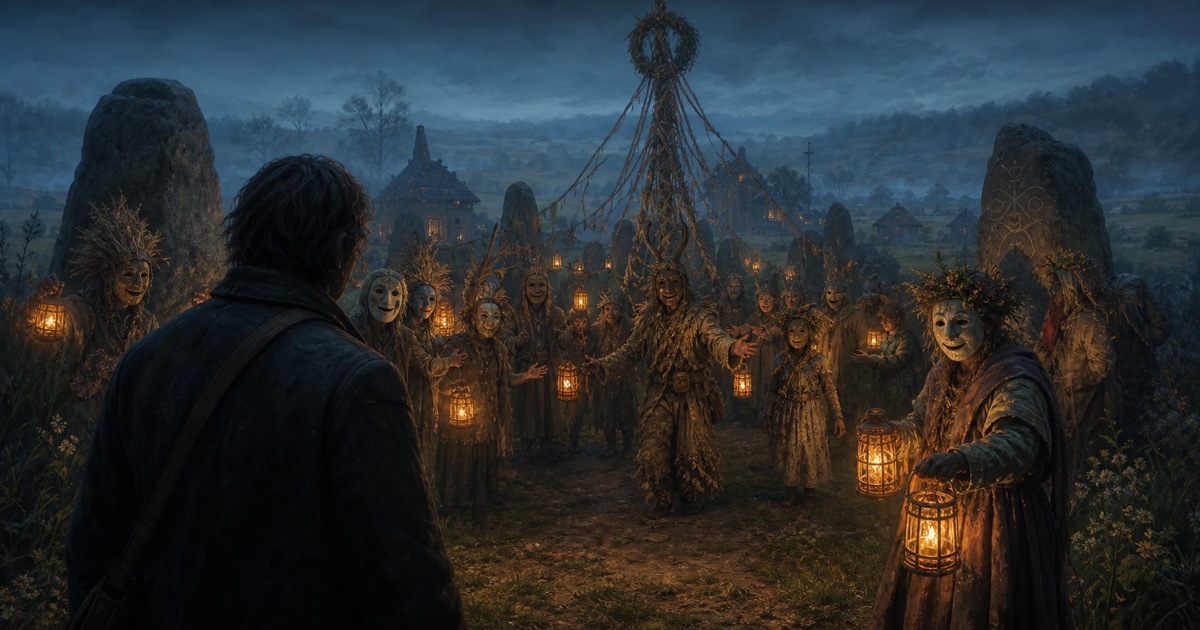
The bus drops you at the top of the lane, and the valley below is the most beautiful thing you have seen in months. Stone cottages the color of honey. A green with a maypole still up, late in the season. A woman shelling peas looks up with real delight — not politeness, delight — and calls your name before you have given it. By evening you have been fed twice and promised a seat at the festival. Everyone is so glad you came. They keep saying it. We're so glad you came. You start to wonder when anyone last left.
Folk horror games are the games that live inside that wondering — the wondering is the whole genre. They are stories set in remote, sunlit, smiling communities where the dread is social rather than supernatural, at least at first. The horror is not a monster in the dark. It is the harvest custom nobody will explain, the festival date everyone knows but you, the slow understanding that the village's extraordinary warmth has terms. And because that horror is learned through conversation — through what people say, and pointedly don't — it may be the one horror subgenre that works better as a story you can talk to than as anything else.
What makes folk horror different from other horror
Most horror isolates you physically. The house is empty, the woods are dark, the phone is dead. Folk horror does the opposite: it surrounds you with people. Friendly people. People who bring you bread and ask about your journey and touch your arm when they laugh. The isolation is social — you are the only person in the valley who doesn't know the thing everyone else knows, and every kindness widens that gap instead of closing it.
This is why the genre's classic settings are so aggressively pleasant. The wildflower meadow. The midsummer bonfire. The little church fete with its jam competition. Folk horror discovered something the haunted-house tradition never needed: that a smile held one second too long is more frightening than a scream, because a scream tells you where the danger is. A smile tells you it's everywhere, and it likes you.
The genre's second discovery is the custom. Every folk horror story turns on some piece of local practice — a dance, an effigy, a day of the year — that is treated as utterly ordinary by everyone around you. Nobody hides it. That's the trick. It is discussed openly, cheerfully, in fragments: after the Reaping, of course — well, not until the chair is filled — you'll see, you're here at just the right time. The horror isn't concealed. It's assumed. You are the only one who needs it explained, and no one thinks to explain it, the way no one explains gravity.
Why folk horror games work as conversation
Notice what both of those discoveries have in common: they happen in dialogue. You learn folk horror by talking to people. Not by finding a bloodstained journal, not by turning a corner at the wrong moment — by chatting. The vicar mentions the old ways with a chuckle. The publican's wife goes quiet at a name. A child recites a counting rhyme whose last line the adults hush. The genre's information economy runs entirely on conversation, which means its natural home is a form where conversation is the way you play.
Consider how the standard folk horror plot actually proceeds. An outsider arrives. The outsider asks questions. The community answers — warmly, incompletely, each answer a door that opens onto a hallway of further doors. The tension isn't whether you can outrun something. It's whether you can ask the right person the right question before the calendar runs out. That is not an action structure. It's an inquiry structure, closer to a mystery than a slasher — which is why folk horror sits so comfortably beside the tradition of horror that never needs a jump scare. Nothing lunges at you. The fear accumulates through understanding, and understanding is something you talk your way into.
Film can only show you this. A game with fixed dialogue options can let you sample it. But the genre's specific pleasure — the sense that you could have asked about the empty chair at supper, that you noticed the sexton's tattoo and said nothing, that the question you didn't ask was the one that mattered — needs a story that can take any question you put to it. Rural horror, played as a story game, becomes a test of your own curiosity: how hard will you press these kind people, and how much of their kindness are you willing to spend to get an answer?
Daylight dread
There is one more thing folk horror refuses that games have historically depended on: darkness. The genre's signature scenes happen at noon. Ribbons in sunlight. A procession across a golden field. The terrible thing, when it finally arrives, arrives in full daylight with everyone watching and everyone pleased.
This matters for how it feels to play. Darkness-based horror manages your body — heart rate, startle reflex, the animal refusal to walk down the unlit corridor. Daylight dread manages your mind. Nothing in the scene is threatening; the threat is the pattern behind the scene, and you assembled that pattern yourself, out of pleasant conversations, over days. When it finally resolves — when you understand what the Reaping is, what the chair is for, why they are so glad you came — the fear has no object you can point to. It's structural. You're not afraid of a thing in the room. You're afraid of the room's arrangement, and the room is a whole village, and the village is delighted with you.
The pagan trappings — the corn dollies, the standing stones, the god with too many local names — are set dressing for this deeper machinery. What's under the wicker is always the same proposition: the community works. The harvests come in. The children are healthy. It costs one thing, occasionally, and everyone here has long since decided the price is fair. The genre's true horror is watching yourself begin, in small daylight increments, to see their point.
Playing the outsider yourself
This is the kind of horror an AI story game is built for. In Runebook, the Storyteller runs the village — the vicar, the publican's wife, the woman shelling peas — and you act by typing whatever you want to say or do. Ask the child to finish the counting rhyme. Refuse the second helping. Slip out during the procession and count the chairs. There's no dialogue menu deciding which questions exist; the question you'd actually ask, in that lane, with that woman smiling at you, is the one you get to ask. And the story remembers what matters, which in folk horror is a great deal: the name that made the room go quiet in your first hour can still be a wound in the conversation three sessions later, when you finally say it again on purpose.
The form fits the genre's other habits, too. Narration is read aloud, which suits a tradition rooted in the spoken tale — folk horror is what campfire stories grow into when they get a whole village to live in. Scene imagery gives you the honeyed light and the leaning treeline. You can walk into the valley alone, or bring friends and arrive as a party of outsiders who must decide together how hard to press their hosts — and if the dread you actually want is the interior kind, the creaking-corridor kind, there's a haunted house waiting instead. Stories resume where you left them, so the festival can stay three days away for as long as you can stand it.
Or begin from your own idea of the place. A fishing village where the catch is always good. A hill town in another country, another century. A commune that advertises. The genre only needs a beautiful somewhere, a warm welcome, and a custom no one explains — the rest, you'll learn by asking.
Create an account and start your first story — it's included. The lane is sunlit, the green is strung with garlands, and everyone will be so glad you came. Start your story.